Challenge Private Parking Debt Recovery

1. What Is a Debt Recovery Charge in Private Parking?
A debt recovery charge in private parking is an additional administrative sum typically £60 to £70 bolted onto an outstanding private Parking Charge Notice (PCN).
Unlike local council parking fines, a private PCN is not a statutory fine; it is an invoice issued under civil contract law for an alleged breach of terms on private land.
When a parking operator (such as ParkingEye, Euro Car Parks, UKPC, or Smart Parking) considers a PCN overdue, they instruct a third-party debt collection agency (such as Debt Recovery Plus or Direct Collection Bailiffs Ltd). The debt recovery charge represents the collection fee added on top of the original £100 base charge, inflating the demand to roughly £160–£170.
2. How Does a Debt Recovery Charge Arise?
A private parking invoice typically escalates to the debt recovery stage in one of four scenarios:
- Ignored or Unpaid Initial Notice: You received the initial windscreen ticket or postal Notice to Keeper (NtK) but did not pay or respond within the standard 14 to 28-day timeframe.
- Missed Internal Appeal Window: You failed to lodge an internal challenge via the operator’s portal within the mandatory 28-day appeal window.
- Rejected Appeal Without Settlement: You appealed to the operator or an independent tribunal (POPLA or the IAS), the appeal was rejected, and you did not pay the full charge within the post-decision deadline.
- Unserved Notices (Address Errors): You had no prior knowledge of the ticket because the original letters were delivered to an outdated address registered with the DVLA.
3. Are Debt Recovery Charges Enforceable?
To determine enforceability, it is essential to distinguish between the debt collector’s authority, the base charge, and the added fees.
A. The Debt Recovery Company Has No Direct Legal Powers
Debt collection agencies act merely as commercial agents on commission. They are not court bailiffs or enforcement agents. They cannot enter your home, clamp your vehicle, seize goods, or issue warrants. Furthermore, they cannot affect your credit score; an adverse entry or County Court Judgment (CCJ) can only occur if the parking operator sues you in court, wins, and you fail to pay the ordered amount within 30 days of the court judgment.
B. The Base Charge Follows Standard Civil Court Processes
While debt collectors cannot enforce payment directly, the underlying parking charge moves through standard civil processes. The parking operator not the debt collector retains the right to initiate a Small Claims Track claim in the County Court.
C. Added Debt Recovery Fees Are Frequently Unenforceable
The £60–£70 markup added by debt collectors is usually retained by the collection company as their fee. However, under Paragraph 4(5), Schedule 4 of the Protection of Freedoms Act (POFA) 2012, keeper liability is strictly capped at the unpaid parking charge stated in the original Notice to Keeper. In County Court proceedings (e.g., Excel Parking Services Ltd v Wilkinson [2020]), district judges regularly strike down these arbitrary add-on fees as an abuse of process and unrecoverable double recovery.
4. Government Consultation & Industry Controversy Around Debt Recovery Fees
The practice of adding £60–£70 debt collection charges to private parking tickets has been heavily criticized by consumer groups, motoring organizations, and government regulators.
A. Government & CMA Position on Debt Collection Surcharges
In the official government consultation for the Private Parking Code of Practice, the government highlighted severe concerns regarding debt recovery fees. The Competition and Markets Authority (CMA) advised that adding arbitrary, pre-set debt collection costs to private parking charges often lacks a contractual basis and risks exploiting consumers.
The government noted that these fees:
- Are routinely added as a blanket surcharge without demonstrating that any actual, reasonable debt collection costs were incurred.
- Are used as a coercive mechanism to intimidate motorists into paying disputed charges out of fear rather than merit.
- Violate fundamental principles of consumer protection by attempting to bypass statutory caps set under POFA 2012.
B. Industry Commentary: The Fight to Ban Debt Recovery Fees
Motoring organisations continue to press for complete legislative prohibition of these surcharges, noting that changes to private parking regulation remain ongoing.
‘Work to do’
Both the AA and the RAC said the new code was a good first step but did not go far enough.
The AA said some drivers pay up even if they have done nothing wrong, just to avoid the hassle and over fears of legal action being taken against them.
“There is still a huge amount of work to do, such as tackling the scourge of debt recovery fees,” added Jack Cousens, head of roads policy at the AA.
“Ultimately, we need to stop charges being issued in the first place, especially where the driver has done nothing wrong.”
The RAC’s head of policy, Simon Williams, called for the banning of debt recovery fees and said the current industry-run appeals bodies should be replaced by a single independent one.
The government said it would be consulting on the issue of debt recovery fees, as well as other recommendations from the Competition and Markets Authority.
5. How to Respond to a Debt Recovery Letter
Ignoring debt collection letters carries no immediate legal penalty, but silence is often interpreted as a non-dispute, increasing the likelihood that the operator will pass the file to solicitors. Sending a formal written dispute puts a clear legal record on file.
Key Strategic Tips for Your Response
- Write Concurrent Letters: Send your dispute in writing to both the debt collection agency and the parking operator.
- Invoke Code Clause 11.2: State explicitly that you dispute the debt in full. Under Clause 11.2 of the Private Parking Sector Single Code of Practice, a formal dispute requires both parties to place all collection activity on immediate hold while the matter is investigated.
- Maintain Registered Keeper Status: Write in the third person (“The driver entered the site…”) and do not disclose who was driving. This forces the operator to prove strict POFA 2012 keeper liability compliance.
- Request Restored Appeal Rights: If you never received the original notices due to an un-updated address or postal loss, cite Clause 10.2 of the Code of Practice, which requires operators to suspend debt collection and offer a restored 28-day appeal window.
- Reject the Added Fees: Explicitly refuse the £60–£70 debt collection surcharge, citing Excel v Wilkinson, POFA 2012 Schedule 4 Paragraph 4(5), and Regulation 5 of the Consumer Protection from Unfair Trading Regulations 2008 (CPUTR).
- Demand Strict Evidentiary Proof: Require the operator to supply full-resolution ANPR entry/exit images, contemporaneous signage photos, and an unredacted landowner contract proving they have written legal standing to operate on that land.
- Embed a Subject Access Request (SAR): Include a formal request under UK GDPR Article 15 and the Data Protection Act 2018 requiring the operator and debt agent to disclose all personal data held, including DVLA KADOE requests and address-tracing logs within 30 days.
6. How to Send Your Debt Recovery Response
- Keep It Written: Never call the debt collection agency. Phone calls are recorded and frequently used to extract admissions regarding driver identity.
- Use Digital Portals or Tracked Post: Submit your response via the debt collection agency’s web portal to generate an instant timestamp, or send it by Royal Mail Signed For / Recorded Delivery.
- Retain Full Records: Keep copies of your written letter, proof of postage, delivery receipts, and any portal confirmations.
7. Expected Outcomes After Debt Recovery Response
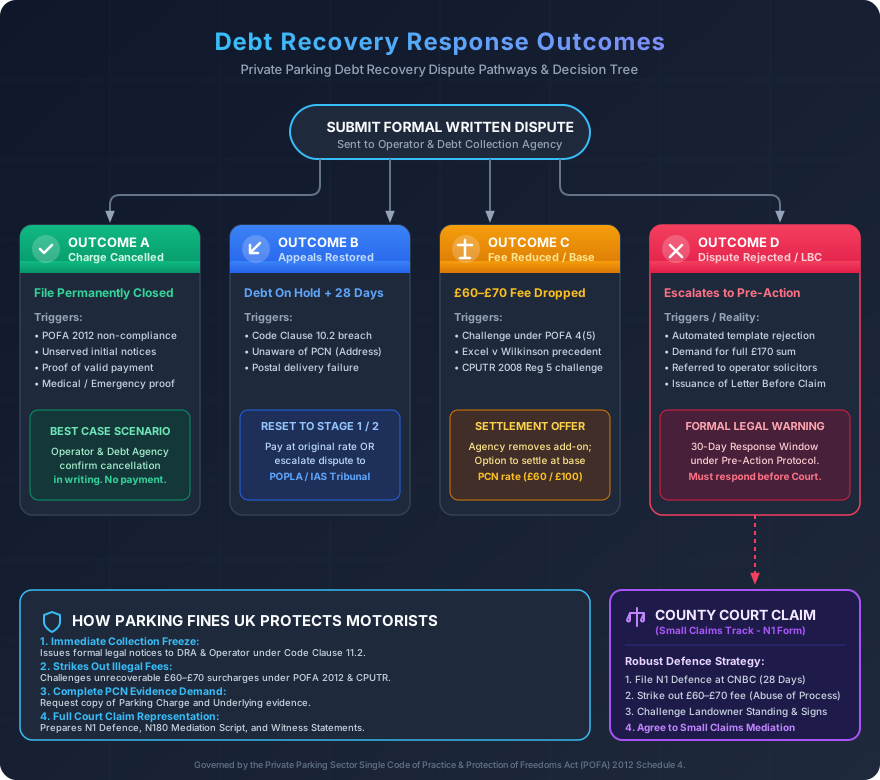
Once you submit a formal written dispute, the case will progress to one of four potential outcomes:
Outcome A: Charge Cancelled and File Closed (Best Case)
If your dispute identifies fatal procedural breaches such as non-compliance with POFA 2012 delivery deadlines, failure to provide proof of posting, or an unredacted landowner contract the operator or debt agency will cancel the PCN and close the file in writing.
Outcome B: Debt Collection Suspended & Appeal Rights Restored
If you proved that you did not receive prior notices due to an address change or postal error, Clause 10.2 obliges the operator to halt debt collection and grant a fresh 28-day window to pay at the original rate or submit an independent appeal via POPLA or the IAS.
Outcome C: Fee Reduced & Opportunity to Pay
The operator or debt agent may acknowledge that the added £60–£70 fee is unrecoverable in court and drop the surcharge, giving you an opportunity to settle the original £60 discounted rate or £100 base charge to conclude the matter.
Outcome D: Dispute Rejected and Escalation to Pre-Action Litigation
If the operator refuses your dispute, they may instruct solicitors (e.g., DCB Legal, BW Legal, or Gladstones) to send a formal Letter Before Claim (LBC). Under the Pre-Action Protocol for Debt Claims, you are given 30 days to respond before a County Court claim form (N1) is issued.
Defending in Court: If a court claim is filed, you can file a formal defence with the Civil National Business Centre. You can defend the claim based on lack of contract, inadequate signage, missing landowner authority, and POFA non-compliance, while asking the judge to strike out the £60–£70 debt fee as an abuse of process under Excel v Wilkinson.
8. Debt Recovery (FAQ)
Can debt recovery agents send bailiffs to my house?
No. Debt collection agents are not court bailiffs. Bailiffs can only be appointed if a parking company sues you in the County Court, a judge issues a CCJ against you, and you fail to pay the ordered sum within the court-mandated deadline.
Will receiving a debt recovery notice ruin my credit rating?
No. A debt recovery demand has zero effect on your credit score. Private parking tickets do not appear on credit files unless the operator takes court action, wins a financial judgment, and you fail to pay it within 30 days.
What happens if I ignore debt recovery letters?
While debt collectors cannot enforce payment themselves, ignoring them means the file may be referred back to the parking operator, who may instruct solicitors to issue a formal Letter Before Claim. Ignoring court pre-action papers can lead to a default judgment.
What should I do if I receive a “Letter Before Claim” from a solicitor?
Do not ignore a Letter Before Claim. Under Pre-Action Protocol rules, you have 30 days to respond. Use the provided reply form to deny the debt, outline your legal grounds (e.g., lack of landowner authority, unserved notices, or unreasonable fees), and request full documentary evidence before any court claim can be issued.

The Parking Fines Editorial Team publishes practical guidance on parking charge notices, penalty charge notices, appeals and enforcement procedures across the UK.