How to Appeal Private Parking Tickets: 2026 POPLA Rules & Reforms
By Consumer Rights Champions
For years, private parking operators across Great Britain have run a multi-million-pound extortion racket disguised as standard contract enforcement.
Motorists are all too familiar with the routine: pull into a bay, misread an unlit sign hidden behind overgrown ivy, type an “O” instead of a “0” into a malfunctioning touchscreen, or return to your vehicle three minutes late because of an overrunning doctor’s appointment and boom: a £100 demand lands on your doormat.
In This Article
If you have ever felt that private parking charges are designed to penalize honest human error rather than manage parking space fairly, the latest official figures confirm your suspicion.
An assessment of the POPLA (Parking on Private Land Appeals) Annual Report 2025 alongside its Annual Report Appendix Data, combined with recent reporting from Sky News, BBC News, and official UK Government Announcements, reveals a massive shift in consumer enforcement.
The tables are turning. Private operators are forfeiting cases at unprecedented rates when challenged properly, and statutory reforms are reining in aggressive private enforcement practices.
1. The 50.5% Win Rate: Why Parking Operators Are Surrendering En Masse
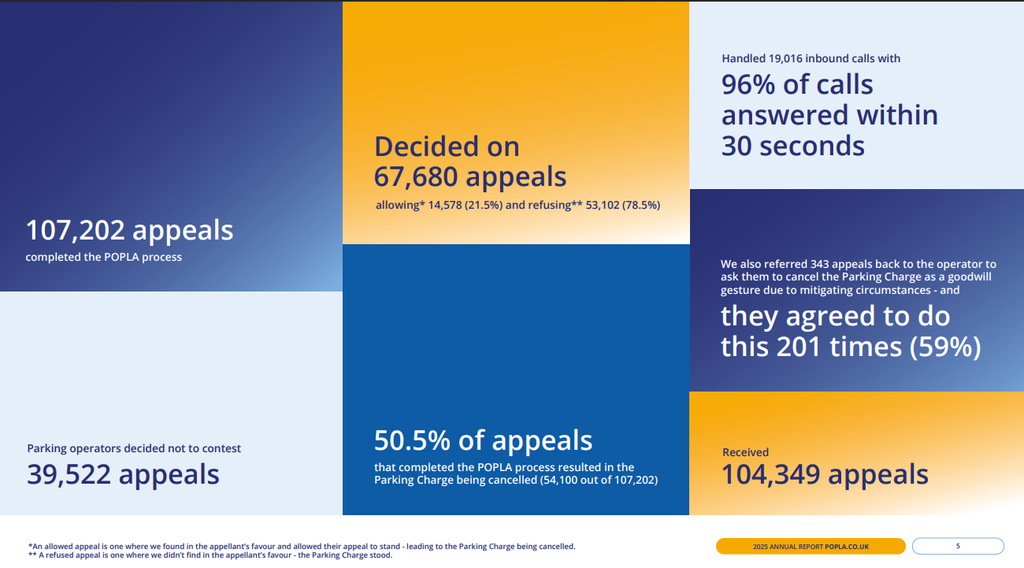
The central takeaway from the POPLA Annual Report 2025 is clear: more than half of all motorists who take their fight to independent appeal win.
Out of 107,202 completed appeals processed by POPLA, 50.5% (54,100 parking charges) were formally cancelled.
However, looking beneath the headline win rate reveals a striking detail: operators are surrendering without a fight.
As detailed in the POPLA 2025 Appendix and analyzed in Sky News coverage, 73.1% of all motorist wins (39,522 cases) occurred because the parking operator withdrew or chose not to contest the appeal.
Why are private parking firms walking away from millions in revenue? Because their business model relies on uncontested compliance. Issuing an automated £100 ticket costs an operator pence; defending that ticket in front of a POPLA assessor costs them time, administrative overhead, and evidence collation.
When presented with a structured, legally sound appeal, operators frequently calculate that pursuing the claim is no longer commercially viable and quietly drop it.
2. Key Findings & Friction Points in the 2025/2026 POPLA Data
The official reporting highlights five core structural issues defining private parking disputes:
A. AI-Generated “Cookie-Cutter” Appeals Are Failing
While motorists are winning in record numbers, POPLA issued an explicit warning regarding the surge of generic AI-generated appeal scripts.
“Appeals submitted using generalized artificial intelligence templates often rely on irrelevant legal assumptions, non-existent case law, or copy-pasted rhetoric that fails to address site-specific facts.”
Assessors are rejecting blanket, unevidenced AI scripts. To win at POPLA, your appeal must connect statutory breaches (like POFA 2012 or British Parking Association Code rules) directly to clear, photo-evidenced realities on the ground.
B. Crucial Protection for Minor “Keying Errors”
Typos at payment kiosks remain a primary source of unfair charges. POPLA reiterated that operators cannot penalize drivers with £100 demands for minor typos (such as confusing the letter “I” for the number “1”, or “O” for “0”). Under the standard framework, minor keying errors require complete ticket cancellation, while major errors (such as entering an entirely different household vehicle registration) limit the operator’s maximum recovery to a nominal £20 administration fee.
C. Blue Badge and Equality Act 2010 Interventions
POPLA stepped in against operators issuing tickets to disabled motorists due to intentionally vague or hidden terms regarding local Blue Badge registration. Under the Equality Act 2010, service providers must make reasonable adjustments. POPLA forced multiple operators to update their site signage to clearly state whether physical Blue Badges apply or require kiosk validation, ruling in favor of drivers where sign clarity was deficient.
D. Airport Drop-Off & “Relevant Land” Defences
Drop-off zones at major UK airports continue to generate a disproportionate volume of appeals. Statutory enforcement under Schedule 4 of the Protection of Freedoms Act 2012 (POFA) allows operators to transfer financial liability from an unknown driver to the registered keeper only on “relevant land.”
Because statutory airport grounds and private port roads are subject to local airport byelaws, they do not legally constitute “relevant land” under POFA 2012. Operators who attempt to hold keepers liable for airport charges routinely forfeit their claims upon receiving a formal legal challenge.
3. The Political Tide Turns: Government Crackdown on Private Parking
The findings in the POPLA report coincide with government policy shifts aimed at reining in private parking practices.
As published in the official UK Government Announcement:

“Being a few minutes late back to your car or typing one digit of your numberplate wrong shouldn’t end with a hefty fine landing on your doormat. These charges leave people feeling ripped off and out of pocket, so I’m putting a stop to them.”
Prime Minister Andy Burnham
Echoing these protections, Housing and Communities Secretary Angela Rayner declared:
“Parking should be straightforward, not another everyday hassle. These changes mean drivers get a fairer deal, protected time to park and leave without fear of being unfairly charged…”
Key Statutory Reforms Under the New Code of Practice:
- Mandatory Grace Periods: Statutory 10-minute grace periods at the end of paid sessions, alongside standard consideration periods upon entering a site.
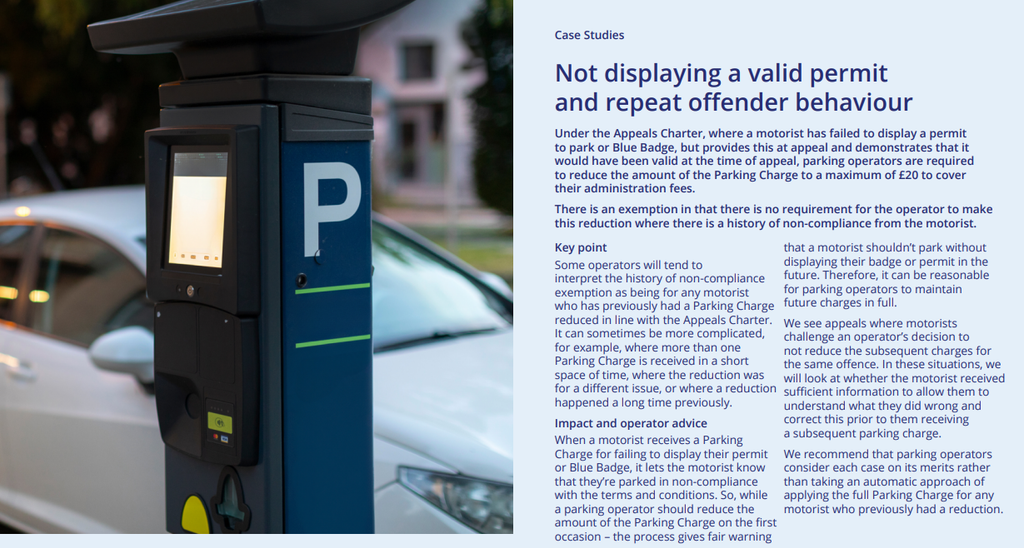
- Capped Minor Error Charges: Maximum £20 capped settlement for accidental registration inputs or forgotten permits.
- Scrutiny & Oversight Board: Creation of an independent oversight body requiring private operators to report detailed data on charge volumes and rejection rates.
- Debt Collection Fee Ban: Consultation on eliminating or drastically cutting the arbitrary £70 “debt collection” surcharge slapped onto overdue demands.
4. Master Blueprint: Consolidated Parking Appeal Grounds
If you have received an unjust Parking Charge Notice (PCN) from a private operator like Parkingeye, Euro Car Parks, or Smart Parking, do not rely on simple excuses or generic AI complaints. Frame your challenge using these ten consolidated grounds of appeal:
| Ground of Appeal | Primary Legal basis & Application |
| 1. Inadequate & Non-Compliant Signage | Contract is void if signs are obscured, unlit, unreadable from the driver’s seat, or lack mandatory UKAS-accredited entrance visibility metrics. |
| 2. Ticket & Operator Inaccuracies | Errors in vehicle registration, timestamps, location markers, or failure to establish vehicle presence on site. |
| 3. Payment System & App Failures | Technological failure (broken pay machines, crashed apps, phone signal blackspots) where no reasonable alternative payment method existed. |
| 4. Accidental Keying Errors | Complete cancellation for minor typos (e.g., “0” vs “O”); maximum capped £20 settlement for major registration mix-ups under code charter rules. |
| 5. Grace & Consideration Period Breaches | Failure to provide minimum 5–10 minute consideration period on entry or 10-minute grace period upon exit. Covers ANPR errors capturing queue times. |
| 6. Genuine Customer Exemption | Proof of purchase, valid hotel stay, or venue receipt. Complaints escalated directly to landowners often force mandatory operator cancellation. |
| 7. Exceptional Mitigating Circumstances | Evidenced medical emergencies, vehicle breakdowns, or severe unforeseen delays. |
| 8. Non-Compliance with POFA 2012 | Operator forfeits rights to hold the registered keeper liable if Notice to Keeper fails to arrive within 14 days or lacks mandatory statutory text. |
| 9. Equality Act 2010 (Blue Badge) | Failure to make reasonable adjustments for disabled drivers. Submitting a valid badge copy on appeal caps any charge at £20 maximum. |
| 10. “Relevant Land” Airport Loopholes | Statutory byelaw-governed sites (airports, ports, railway lands) are excluded from POFA 2012 keeper liability rules. |
5. How to Appeal a Private Parking Charge
If a private parking charge lands on your windscreen or doormat, follow this tactical step-by-step process or use Parking Fines UK automated appeal process here:
Step 1: Never Ignore the Notice
Ignoring private parking charges is a mistake. Unchallenged tickets escalate to debt collectors and potentially small claims court (CCJs). Always contest within specified deadlines.
Step 2: Appeal Directly to the Operator & Landowner (First Stage)
Submit your initial formal written challenge directly to the operator within 28 days (or 14 days to preserve discount rates where applicable). Include photographic evidence, receipts, bank statements, or proof of breakdown.
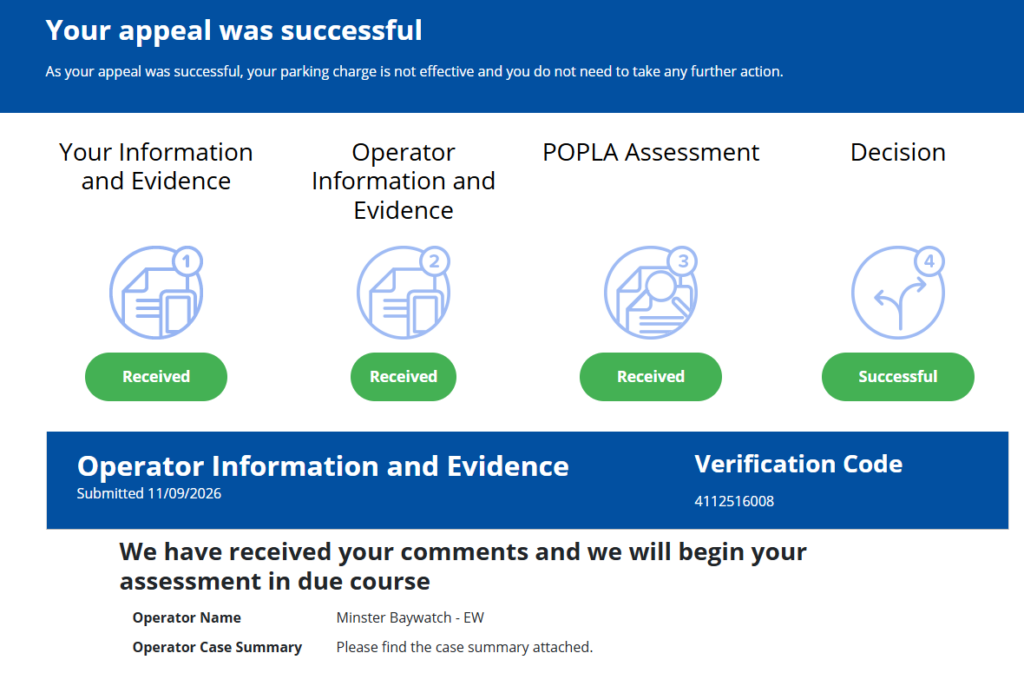
Step 3: Secure Your POPLA Verification Code
If the operator rejects your initial appeal which they frequently do via automated responses they must legally issue a 10-digit POPLA Verification Code.
Step 4: Submit a Detailed POPLA Appeal
You have 28 days from the date of the operator’s rejection letter to lodge your formal POPLA challenge online.
- Combine site photographs with specific legal points (POFA 2012 non-compliance, signage geometry, grace period math).
- Avoid emotive prose; state the facts cleanly and upload properly formatted, clearly labelled evidence attachments.
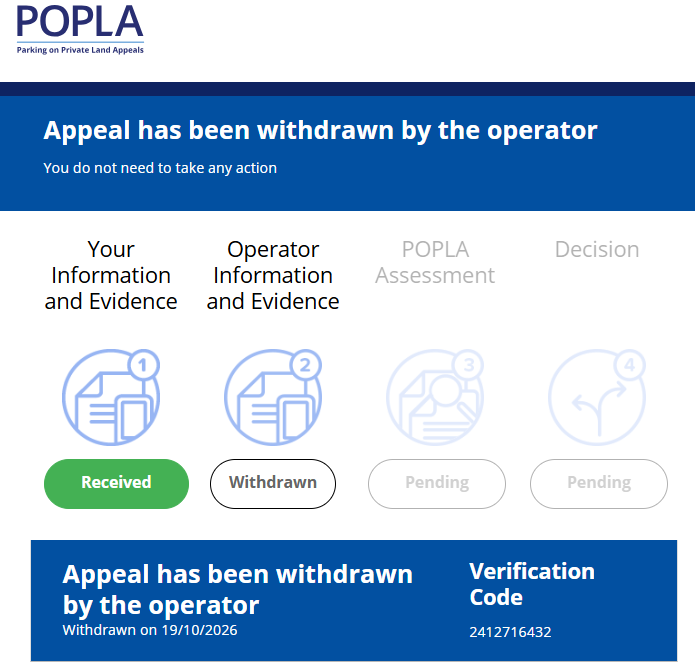
- However, a finding of Parking Fines UK is often, as soon as the appeal is lodged, the operator will withdraw.
Step 5: Force the Operator’s Hand
Once your structured appeal is registered at POPLA, the operator must pay an administrative fee to defend it. As the 2025 POPLA data proves, in nearly 4 out of 10 cases, the operator will simply withdraw. If they fight and you win, the decision is legally binding on the operator, forcing them to cancel the charge permanently.
The Bottom Line
Private parking operators rely on intimidation, confusing jargon, and customer frustration to collect penalties. But the official data from the POPLA 2025 Annual Report proves that when drivers push back using formal appeal grounds, the odds are overwhelmingly in their favor.
Don’t pay for systemic app crashes, unlit signs, or innocent typing errors. Hold operators accountable, use statutory grounds, and exercise your rights.