How To Defend Parking Court Claim (2026 Defence Guide)
A Parking Court Claim N1 Form from the Civil National Business Centre (CNBC) issued by operators like ParkingEye, Civil Enforcement Ltd, Euro Car Parks, or Smart Parking through legal representatives like DCB Legal, Gladstones Solicitors, or BW Legal does not mean you have lost, nor does it automatically place a mark on your credit record.
A Claim Form represents the start of formal legal proceedings. By following civil procedure rules, you can file a formal defence, challenge unlawful fees, and seek to have the claim dismissed or discontinued. Services like Parking Fines UK provide free advice on how to defend your claim and professional support to defend your parking court claim.
Private parking charges are civil contractual demands, not statutory council fines. When an operator files a parking court claim, the case enters the Small Claims Track under the Civil Procedure Rules (CPR).
If you follow the correct procedural steps, challenge unrecoverable surcharges, and file a formal defence, parking firms frequently discontinue claims rather than face a judge in court.
1. Civil National Business Centre (CNBC) Claim Trends
- Rising Claims Volumes: According to the Ministry of Justice (MoJ) Civil Justice Statistics Quarterly, overall County Court claims reached 571,000 in Q2 2026 (an 11% year-on-year increase).
- Money Claims Surge: 87% of all civil court claims (495,000) were specified money claims, heavily driven by bulk private parking filings.
- Defences on the Rise: Motorists defended 82,000 claims in Q2 2026 a 15% increase year-on-year reflecting growing public awareness around challenging unrecoverable debt fees and POFA non-compliance.
- Drop in Actual Trials: Despite the rise in defended claims, actual court trials dropped by 10% (to 12,000). This confirms that legal firms routinely discontinue claims once faced with a structured defence bundle rather than paying court hearing fees.
- Default Judgment Rate: 94% of all judgments are default judgments, demonstrating why filing a formal defence stops automatic CCJs.
2. Defences That Win Parking Court Claims
Your written defence must address the specific legal defects in the Claimant’s Particulars of Claim. Under CPR 16.5, you must specifically state which allegations you admit, deny, or require the Claimant to prove.

Ground 1: Double Recovery & Striking Out Inflated Fees (CPR 3.4 / CPR 27.14)
Parking operators routinely inflate a £100 parking charge to £170, £240, or £340+ by adding arbitrary “debt recovery costs” or “legal administration fees”.
- POFA 2012 Schedule 4, Paragraph 4(5): Strictly caps the maximum sum recoverable from a registered keeper to the unpaid parking charge stated in the original Notice to Keeper.
- The Beavis Precedent (ParkingEye Ltd v Beavis [2015] UKSC 67): The Supreme Court held that the £85 charge in Beavis already fully covered all pre-action administrative and debt collection costs. Adding fake secondary “fees” constitutes an impermissible penalty and unlawful double recovery.
- Court Striking Out Powers: Under CPR 3.4(2)(a), courts frequently strike out private parking claims on the basis that adding false debt collection fees constitutes an abuse of process.
Ground 2: Keeper Liability Failures (POFA 2012 Schedule 4)
If the operator is pursuing you as the registered keeper, they must prove strict compliance with Schedule 4 of the Protection of Freedoms Act 2012:
- Notice to Keeper (NtK) Deadlines: For ANPR capture cases, a compliant NtK must be delivered within 14 days of the alleged parking event.
- Mandatory Statutory Wording: The NtK must contain specific statutory warnings inviting the keeper to pay or identify the driver.
- No Presumption of Driver Identity: If the operator fails to meet POFA 2012 criteria, keeper liability does not apply. There is no legal presumption that the registered keeper was the driver on the day.
Ground 3: Inadequate Signage & Lack of Contract Formation
Private parking tickets are civil contractual demands. To form a binding contract, there must be clear offer, acceptance, and prominent terms.
- Under Sections 62 and 71 of the Consumer Rights Act 2015, key terms including the penalty charge sum must be transparent, prominent, and legibly lit.
- If signs were sparse, obscured by foliage, unlit at night, placed too high, or absent at the entrance, no contract was formed.
Ground 4: Sparse or Vague Particulars of Claim (CPR 16.4)
Law firms like DCB Legal or Gladstones often use automated “bulk claim” templates that fail to specify the precise cause of action, the exact location, arrival/departure timestamps, or the specific contractual term broken. Under CPR 16.4 and Practice Direction 16, a claimant must state all facts necessary to formulate a complete cause of action.
Ground 5: Lack of Landowner Standing
Private parking firms act merely as commercial agents. They do not own the land. Under the BPA/IPC Single Code of Practice, the operator must possess written landowner authority granting them standing to issue charges and initiate court proceedings in their own name.
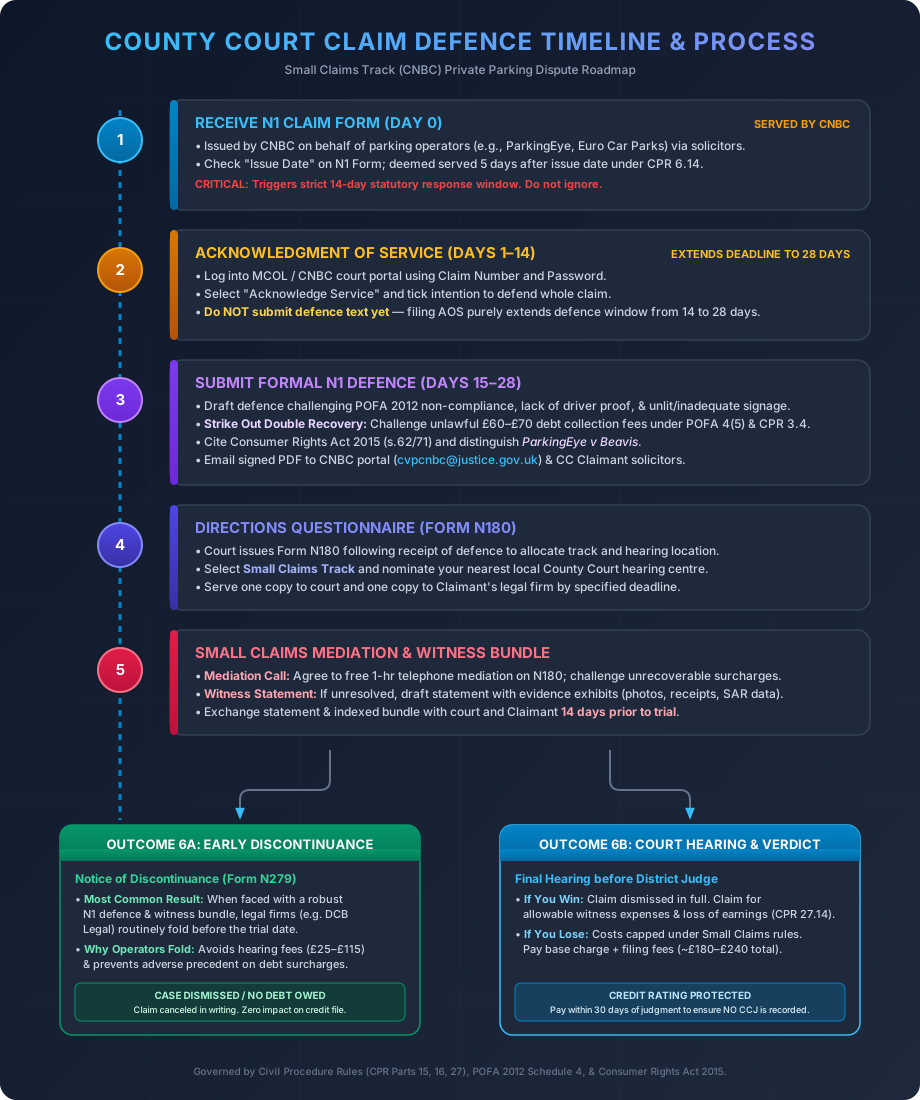
3. Parking Court Claim Defence Process
Step 1: Receive Claim Form (Day 0)
- Action: You receive a Parking Court Claim N1 Form from the Civil National Business Centre (CNBC) in Northampton.
- Key Detail: Check the “Issue Date” on the front of the form. Under Civil Procedure Rules (CPR 6.14), the form is legally deemed served 5 days after the issue date.
Step 2: Acknowledgment of Service (Days 1–14)
- Action: Log into the court portal (Money Claim Online / MCOL) using the Claim Number and password provided. Select “Acknowledge Service” and tick that you intend to defend the whole claim.
- Key Detail: Submitting the AOS extends your total deadline to respond from 14 days to 28 days from the deemed date of service. Do not enter any defence text at this stage.
Step 3: File Formal N1 Defence (Days 15–28)
- Action: Draft and submit your written Defence to the CNBC (
cvpcnbc@justice.gov.uk) and CC the Claimant’s legal firm (e.g., DCB Legal or Gladstones).
- Action: Draft and submit your written Defence to the CNBC (
- Key Detail: Your defence must outline your legal grounds such as non-compliance with the Protection of Freedoms Act (POFA) 2012, lack of landowner standing, inadequate signage, or illegal double recovery of £60–£70 debt fees (Excel Parking v Wilkinson).
Step 4: Directions Questionnaire (Form N180)
- Action: Once the court processes your Defence, both parties are sent an N180 Directions Questionnaire.
- Key Detail: Complete the form indicating that you agree to the Small Claims Track and specify your preferred local County Court hearing centre. Send one copy to the court and one to the Claimant’s legal firm.
Step 5: Small Claims Mediation
- Action: On your Form N180, tick “YES” to agree to free Small Claims Mediation.
- Key Detail: A court-appointed mediator will conduct a 1-hour telephone session. This provides a formal opportunity to highlight procedural defects or demand that unrecoverable debt recovery fees be removed. If no agreement is reached, the case proceeds to a hearing.
Step 6: Exchange Witness Statements & Evidence Bundle
- Action: The local County Court issues a Notice of Hearing setting the trial date and ordering both parties to exchange Witness Statements and evidence bundles.
- Key Detail: You must file your Witness Statement along with attached exhibits (signage photos, payment app receipts, SAR logs) with the court and serve a copy on the Claimant at least 14 days prior to the hearing date (or as specified in the judge’s directions order).
Step 7: Final Hearing & Case Outcome
Pathway A: Early Discontinuance (Most Common Outcome)
Important Note on Discontinuance: When parking companies and legal representatives (such as DCB Legal) are presented with a robust, legally structured N1 Defence and a comprehensive Witness Statement bundle, they frequently issue a formal Notice of Discontinuance (Form N279) shortly before the trial date.
They do this to avoid paying mandatory court trial fees (£25–£115) and to prevent setting a binding adverse judicial precedent on unrecoverable £60–£70 debt collection charges. If you receive a Notice of Discontinuance, the court proceedings are immediately cancelled, and the case is closed with no debt owed.
Pathway B: County Court Hearing & Judicial Verdict
If the Claimant proceeds to trial, both parties appear before a District Judge at your local County Court:
- If You Win: The claim is dismissed. You owe nothing, and you can apply for allowable witness loss-of-earnings expenses and travel costs under CPR 27.14.
- If You Lose: The judge orders you to pay the judgment sum. On the Small Claims Track, costs are capped, meaning you typically only pay the original base charge (£60–£100) plus fixed court filing fees (totaling roughly £180–£240).
- Credit Rating Protection: As long as you pay the court-ordered judgment amount within 30 days of the judge’s order, no County Court Judgment (CCJ) will be recorded on your credit register.
(Note: When presented with a thorough, well-drafted legal defence bundle, solicitors such as DCB Legal frequently issue a Notice of Discontinuance right before the hearing to avoid paying court hearing fees).
4. Parking Court Claim Defence Service
Receiving a Parking Court Claim Form from the Civil National Business Centre (CNBC) can be daunting if you face it alone. With Parking Fines UK, you get end-to-end support to defend your claim, strike out illegal debt recovery fees, and defend against paying £300 or more in inflated charges.
Rather than simply acting as an agent that forwards court emails back and forth, our team of specialist agents works actively on your behalf. We craft bespoke legal arguments, prepare every required court document, and manage the complete lifecycle of your claim from receipt of the N1 form to the final case resolution.
Complete Parking Court Claim Lifecycle Support
- Custom N1 Defence Preparation: Get a tailored, court-ready Defence generated in under 5 minutes. Our specialist agents draft full legal grounds challenging non-compliance with the Protection of Freedoms Act (POFA) 2012, lack of driver identity proof, poor signage, and unrecoverable double recovery fees.
- Form N180 Directions Questionnaire: We prepare and file your Directions Questionnaire, ensuring your case is allocated to the Small Claims Track at your local County Court hearing centre.
- Tailored Mediation Script: Small Claims Mediation is a crucial stage to challenge unrecoverable surcharges. We provide you with a customized mediation script and step-by-step guidance so you can negotiate with confidence.
- Comprehensive Witness Statement & Evidence Bundle: If your claim proceeds past mediation, our specialists compile a fully indexed Witness Statement and evidence exhibit bundle ready for court submission.
Why Choose Parking Fines UK?
- Hands-On Claim Management: We don’t just pass along emails from the court or claimant solicitors. Our specialist agents monitor every deadline, manage filings, and handle the claim lifecycle end-to-end.
- Protect Your Credit Score: A parking court claim only impacts your credit score if you ignore it or fail to pay a judgment within 30 days. We make sure your defence is filed correctly and on time to prevent default CCJs.
- Proven Track Record: By presenting a structured, legally sound N1 Defence and evidence bundle, parking firms frequently discontinue claims before the trial date to avoid paying court hearing fees.
Defeating The “Default CCJ” Business Model
- 27% Increase in Default Judgments: Judgments issued by the CNBC rose to 368,000, with 94% being Default Judgments where the motorist failed to acknowledge or defend the claim.
- Profit from Silence: Bulk legal firms (e.g., DCB Legal, Gladstones) rely on default judgments. Over 9 out of 10 parking court claims succeed purely because motorists ignore the N1 Claim Form.
- Discontinuance Rates: When defendants file a structured N1 Defence challenging the £60–£70 surcharge and driver identity, over 70% of bulk parking claims are discontinued prior to the trial hearing.
